

Wrestling conditioning is not a contest to see who can leave the room the most wrecked. It is the ability to keep making useful movements when the pace rises. Can you stay in your stance after a hard exchange? Can you clear your hands, take another honest shot and recover fast enough to do it again? That is the kind of gas tank that matters.
A good conditioning plan has to work around real life in the room. Wrestlers already drill, go live, lift, travel, make weight decisions and try to keep up with school or work. Adding more hard work without a purpose usually produces one thing: tired athletes whose technique disappears right when practice is supposed to make them better.
This guide gives you a practical way to build wrestling conditioning without turning every day into a punishment test. It is general training guidance, not a substitute for a coach, athletic trainer or medical professional. If pain, dizziness, unusual shortness of breath or illness shows up, pull back and get qualified help.
1. Define conditioning by what happens late in a match
Most wrestlers do not lose shape because they cannot run in a straight line. They lose position after a scramble, reach with their hands instead of moving their feet, stand too tall in a tie or rush a shot when they should set it up. Conditioning should improve the repeatable work that lets skill stay available under fatigue.
Start by noticing where your wrestling changes. A coach might see that your level changes slow down in the second period. You might feel that your forearms are gone after a heavy hand-fighting session. Another athlete may be able to push a hard pace once but take too long to settle their breathing before the next go. Those observations are more useful than copying the hardest workout from another room.
Build sessions around three questions: can you produce a hard effort, can you recover enough to repeat it, and can you keep your positions while both are happening? The work that answers those questions is specific. The work that only makes you sore is optional.
2. Build an easy base before adding more hard intervals
Hard intervals get the attention because they feel like wrestling. An aerobic base is quieter, but it helps you recover between hard exchanges, rounds and training days. It also lets you get enough total work without turning every session into a fight.
Once or twice a week, use a low-impact option such as an easy run, bike, incline walk, rower or light circuit for 20 to 40 minutes. The pace should be steady enough that you can speak in short sentences. This is not a day to prove toughness. It is a day to practice patience, breathe under control and finish feeling like you could have done a little more.
Choose the option your body tolerates well. A wrestler with shin pain does not need to force more road miles. A bike, sled drag or rower can do the job without adding the same impact. Keep the effort boring on purpose. The hard work will land better when the base is there.
3. Make hard work look more like repeated wrestling effort
Matches are not one smooth pace. They are bursts of hand fighting, an attack, a scramble, a short reset and another burst. Your conditioning should include that rhythm. Instead of doing one long all-out effort, use short work periods you can repeat with intent.
A useful starting point is six to ten rounds of 20 to 30 seconds hard, followed by 40 to 70 seconds easy movement or rest. Hill sprints, a bike, a sled, jump rope, short shuttles or stance-and-motion work can all fit. Start on the lower end, keep the hard interval honest and stop adding rounds once speed or position falls apart.
For a mat-focused option, work in pairs with clear constraints: 20 seconds of hard hand fighting, 20 seconds of attacking from contact, then a controlled reset. Change the drill before it becomes sloppy live wrestling. The goal is to expose the body to repeated effort while still practicing the stance, level change and hand discipline that survive into competition.

4. Use one hard session for quality, not chaos
There is a difference between hard conditioning and random suffering. A quality session has a reason, a clear work period and enough rest that the next repetition still looks athletic. Chaos is just piling movements together until the athlete cannot tell whether they are getting fitter or merely getting beat up.
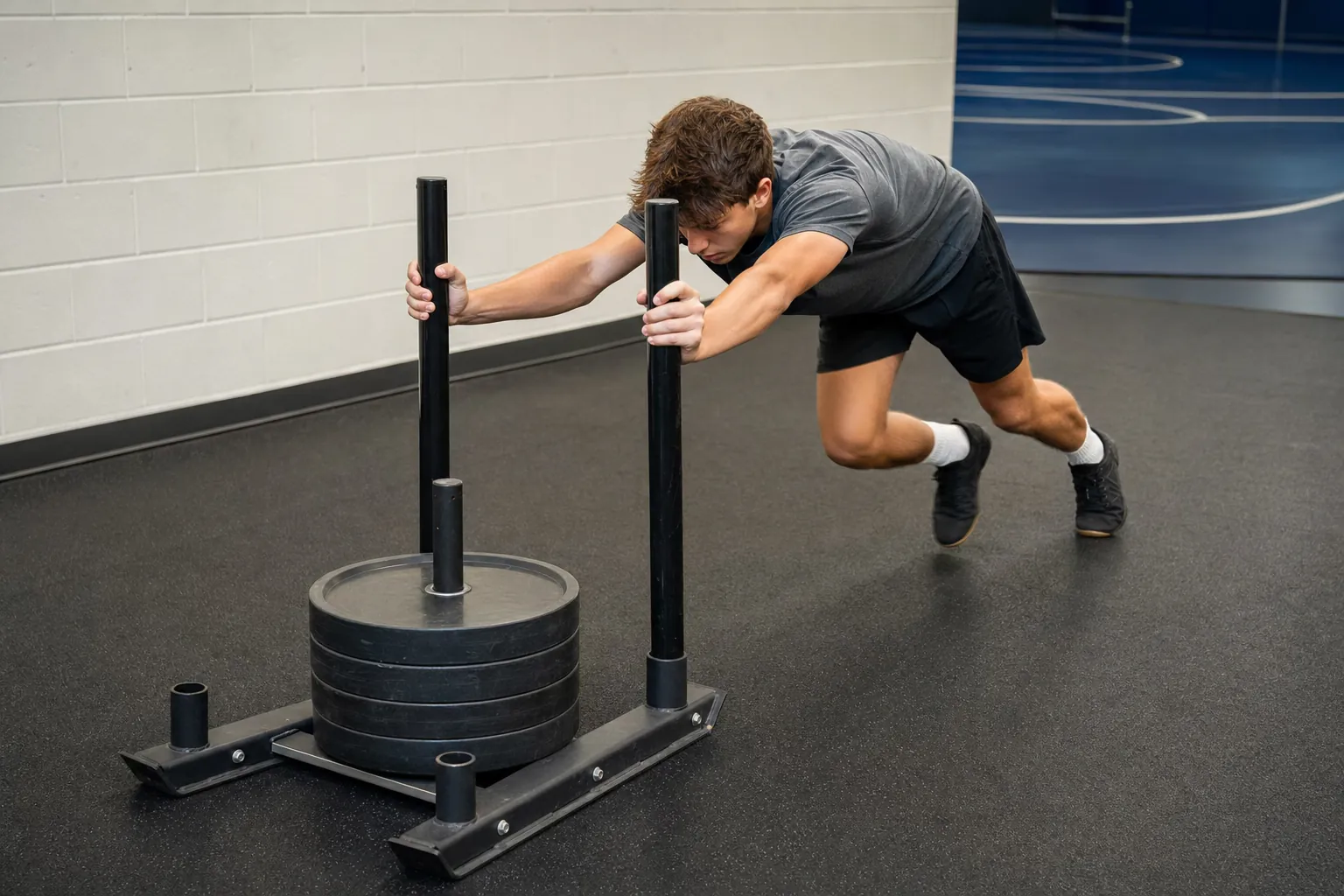
Pick one main tool for the day. If it is hill sprints, keep the hill short and walk back fully. If it is a bike, set a hard repeatable effort and spin easy between rounds. If it is a sled, use a load that lets you drive with a strong body angle instead of taking tiny steps under a pile of weight. A little rest protects the quality of the next effort.
This matters most for younger athletes. Proper progression and technique should lead the plan, not maximal work for its own sake. The National Strength and Conditioning Association’s guidance on youth resistance training makes the same broader point: supervision, sound movement and sensible progressions matter more than flashy training.
5. Keep the mat room as the main event
A dedicated conditioning session should support practice, not steal from it. If live goes are hard on Tuesday and Thursday, place an extra interval session where it has the best chance to recover, often after an easier practice or on a separate day. Do not stack a hard run on top of a brutal live session simply because both are called conditioning.
In season, many wrestlers only need one or two short dedicated sessions each week. The hard rounds at practice already count. In an off-season block, you may have room for more volume, but keep one true lower-intensity day in the week. That is where the body catches up enough to make the next hard day useful.
Use the same standard with strength work. The wrestling strength training guide can help you place lifting around practice, but do not try to make every lift a conditioning circuit. Strength and conditioning can live in the same week without competing for every ounce of energy.
6. Choose tools that let you train hard with good movement
There is no single best conditioning tool for every wrestler. The best choice is the one that lets you push an honest effort, repeat it safely and arrive at practice ready to learn. Rotate tools when it helps your body stay healthy, not because variety is automatically better.
- Hills and short sprints: useful for powerful repeated efforts when you have a safe surface and enough room to recover between reps.
- Sled pushes and drags: a strong option for leg drive with less pounding than repeated flat sprints.
- Bike or rower intervals: useful when you need hard breathing work without loading sore shins, feet or knees.
- Jump rope and shuttles: simple tools for foot speed and rhythm, as long as the work-to-rest ratio stays realistic.
- Stance-and-motion drills: a direct way to train movement quality if you keep the stance low and the effort measured.
Do not turn every option into a maximum test. The most reliable program is the one you can repeat for several weeks, track honestly and adjust before small problems become missed practices.
7. Try this simple two-day wrestling conditioning plan
Day A: Base and movement
Easy conditioning: 25 to 35 minutes on a bike, incline walk, rower or easy run at a conversational pace.
Movement finish: 4 to 6 rounds of 30 seconds stance and motion, 30 seconds easy walk. Keep your hips under you and your hands ready.
Day B: Repeatable hard efforts
Warm-up: 8 to 12 minutes of easy movement, mobility and a few gradual accelerations.
Main work: 6 rounds of 20 seconds hard hill sprint, sled push or bike effort, then 60 seconds easy recovery. Add one round only when the previous week stayed sharp.
Optional close: 3 rounds of 20 seconds hand fighting or shadow shots, then 40 seconds rest. Stop if stance or shot mechanics break down.
Place the hard day away from your hardest live practice when possible. After two or three weeks, do not automatically add more work. First ask whether you are recovering faster, holding position longer and finishing practice with better decisions. Progress can mean a cleaner sixth round, not only a higher number on the workout.
8. Watch for fatigue that is costing more than it gives
Good conditioning is demanding, but it should not leave the same warning signs every week. Persistent heavy legs, poor sleep, unusually low motivation, irritated joints and a sharp drop in practice quality are reasons to reduce the load. The body does not care whether fatigue came from a great-looking program or a bad one.
Sleep, food and hydration are part of the plan. A review of sleep and athletic performance found that inadequate sleep can affect physical performance, reaction time and mood. That is not a detail to ignore when the sport demands clear reactions under pressure. The National Athletic Trainers’ Association heat-illness resources are also worth using for practical prevention and warning signs during hot-weather training.
Take the simple wins seriously: carry water, eat enough after hard sessions, leave room for a full night of sleep and take a real easier day when the week calls for it. Recovery is not a reward for training. It is the part that lets training work.

Bring the pace back to wrestling
Every few weeks, test the plan where it matters. After a hard practice round, can you take one controlled breath, reset your stance and make the next smart decision? Can you finish a clean shot without your feet stopping? Ask your coach what they see. Their view of your posture, hand fighting and decisions under fatigue is more useful than any number on a watch.
Conditioning should make the work before the win more repeatable. Build it with patience, keep the hard days honest and leave enough in the tank to get better at the sport itself. That same standard is what sits behind the Hands Raised story, the wrestlers featured in Athlete Spotlight and the gear in the Combat Sports Hats collection. The reminder is simple. Show up ready to do the next useful rep.
Frequently asked questions
How many days a week should I do wrestling conditioning?
For most wrestlers, two dedicated conditioning sessions each week is enough when practice already includes drilling and live wrestling. Add a third only when the athlete is recovering well and it does not take quality away from the mat room.
What is the best conditioning for wrestlers?
The best conditioning combines a base of easier aerobic work, short hard intervals and live wrestling. It should make you more useful in the positions you actually face, not simply better at surviving a random workout.
Should I run every day for wrestling conditioning?
No. Running can be useful, but daily hard runs often create tired legs without solving the whole problem. Rotate sprint work, hills, a bike, sled work and controlled mat-specific intervals so the body gets a broader stimulus and enough recovery.
How do I know if my conditioning is working?
Look for cleaner technique late in practice, a faster recovery between rounds, and the ability to repeat a hard effort without letting stance, posture or decision-making fall apart. A plan is working when it carries into wrestling, not merely when a workout feels brutal.