
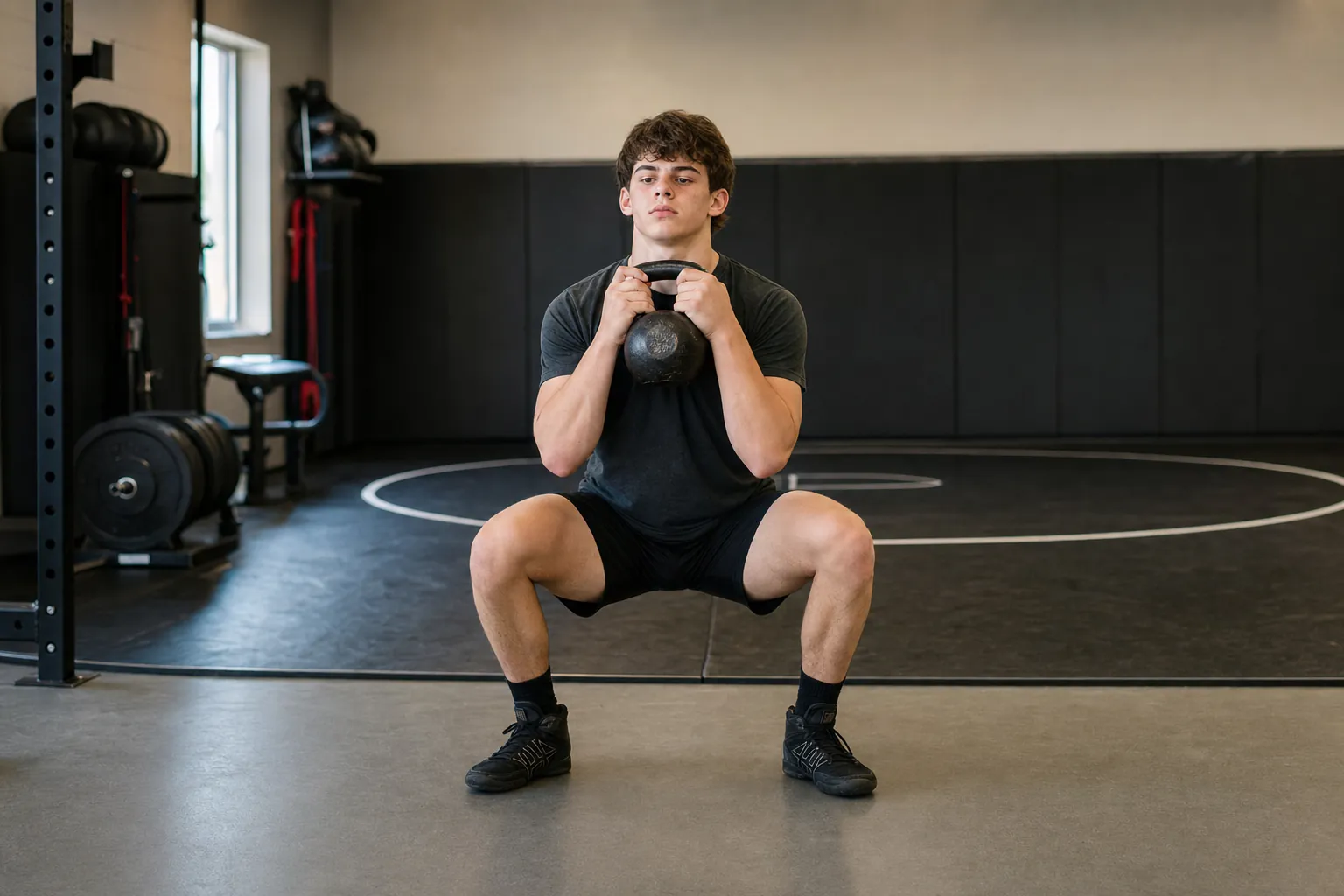
A wrestling workout should leave you more useful in the room, not simply more tired. The point is to build legs that can keep driving, a back that can hold position in a tie, hands that stay active late in a round and a gas tank that lets your skill show up when the pace rises. The best plan is usually less complicated than athletes expect. It gives the basics enough attention, then makes room for practice, school, work, sleep and recovery.
That matters because a wrestler’s week already has a lot in it. Practice can include drilling, live goes, sprinting, technique work and plenty of hard contact. A workout that treats every day like an off-season lifting day can steal from the very practice it is supposed to support. Build the physical side around the mat room, then adjust it when the competition calendar gets heavier.
This is a general guide for wrestlers and parents looking for a sensible starting point. It is not a replacement for a qualified strength coach, athletic trainer or medical professional. If pain changes the way you move, or a coach sees a technical problem, pull back and get the right help before trying to push through it.
Start with the job, not the exercise list
It is easy to collect workouts from social media and end up with a week that asks for everything at once: heavy lifting, long runs, sprints, jumps, grip work and hard live wrestling. The issue is not that any one of those tools is bad. The issue is that a wrestler has a limited recovery budget. When the plan ignores that budget, the first things to disappear are usually sleep, sharp technique and consistent effort.
Start with what you need your body to do in practice. You need to change levels without folding forward, hold posture when someone is pulling on your head, finish an attack with your legs, recover between hard exchanges and stay steady enough to make good decisions. That points to a simple foundation: lower-body strength, pulling strength, pushing strength, single-leg control, trunk work and conditioning that is hard enough to matter but brief enough to recover from.
For younger or newer athletes, a simpler version of each movement is usually the right first choice. The National Strength and Conditioning Association’s youth resistance-training position statement emphasizes qualified supervision, sound technique and gradual progression. A clean goblet squat or well-controlled push-up is more valuable than a bigger lift that changes your position.
Warm up until your positions are ready
A warm-up is not punishment before the real work. It is the short bridge between a long day and the positions you need on the mat. Start with five to eight minutes of easy movement, then move through a few active drills that open up the ankles, hips, upper back and shoulders. Add a couple of light stance-and-motion rounds or short accelerations so the first hard effort is not a surprise.
Keep it practical. You do not need a long routine full of movements you cannot explain. A wrestler could use an easy bike or jump rope, ankle rocks, a lunge-and-reach, controlled hip switches, scapular push-ups and a few crisp level changes. The last few minutes should look more like the sport: stance, motion, clean sprawls, hand movement or a few shadow shots at an easy pace.

Build the strength that holds up under pressure
A solid wrestling workout does not need dozens of exercises. Pick movements you can do well, repeat them long enough to improve and leave the gym with enough energy for the next useful session. Most wrestlers can build a lot with one squat or hinge pattern, one pull, one press, one single-leg movement and one carry or trunk exercise.
- Lower body: goblet squat, front squat, split squat, trap-bar deadlift or Romanian deadlift.
- Pull: pull-up, chest-supported row, cable row or one-arm dumbbell row.
- Push: push-up, dumbbell floor press, dumbbell bench press or landmine press.
- Single leg: reverse lunge, step-up or split squat for balance and control.
- Carry and trunk: farmer carry, suitcase carry, plank, side plank or dead bug.
Choose a load that lets you keep a strong position. If your knees cave in, your back rounds or you need to throw the weight around to finish a repetition, the set has stopped doing its intended job. Leave one or two good reps in reserve most of the time. That gives you room to get stronger week after week instead of turning every session into a test.
The more detailed wrestling strength training guide breaks down these movement patterns and how to place them around a season. Use it when you want to go deeper. For the weekly plan below, keep the goal simple: train the basics with enough quality that they still help when the match gets hard.

Condition for repeatable effort, not chaos
Wrestling conditioning should help you repeat hard efforts while keeping your stance, posture and decision-making available. It should not make you so depleted that the next practice becomes survival. The mat room already provides a large share of your sport-specific conditioning, especially when live rounds are hard. Dedicated work should fill a real gap, not stack fatigue on top of fatigue.
One easy session and one short hard session are a good starting point for many wrestlers. The easy session can be a 20 to 30 minute bike, incline walk, rower or relaxed run at a pace where you can speak in short sentences. The hard session can be six rounds of 20 seconds of hard bike work, hill sprinting, sled pushes or stance-and-motion intervals, followed by 60 seconds of easy recovery. Stop when your posture or speed starts to fall apart.
That structure gives you a base for recovery plus a chance to practice repeated high-quality effort. The wrestling conditioning guide explains how to scale those sessions around live practice and competition weeks. Do not add more intervals simply because the first week felt manageable. First make the existing rounds sharper, then decide whether more work is really needed.
Use this simple two-day wrestling workout
This plan fits many athletes who practice wrestling several times each week. It is not a promise that every exercise or load fits every person. A coach may swap movements based on age, experience, equipment or an old injury. Keep the sessions to about 45 to 60 minutes, including the warm-up, and use weights you can control.
Day A: Squat and pull
Warm-up: 5 to 8 minutes easy movement, then hips, ankles, upper back and stance work.
Goblet or front squat: 3 sets of 5 to 8 smooth reps.
Pull-up or row: 3 sets of 6 to 10 reps.
Push-up or dumbbell press: 3 sets of 6 to 12 reps.
Reverse lunge: 2 sets of 6 to 8 reps per side.
Farmer carry: 3 controlled walks of 20 to 40 yards.
Day B: Hinge and single-leg control
Warm-up: repeat the same simple sequence, then add a few gradual accelerations.
Trap-bar deadlift or Romanian deadlift: 3 sets of 5 to 8 smooth reps.
One-arm dumbbell row: 3 sets of 8 to 10 reps per side.
Landmine press or push-up: 3 sets of 6 to 10 reps.
Step-up or split squat: 2 sets of 6 to 8 reps per side.
Side plank or dead bug: 2 to 3 controlled sets.
Place these sessions away from your hardest live days when possible. If practice is especially demanding on Tuesday and Thursday, Monday and Saturday may work better than stacking another hard lift directly after live goes. The plan is supposed to give you better training weeks, not win an argument about who can do the most.
Change the plan when the season changes
Off-season training gives you more room to build. You may be able to add a third lifting session, more easy aerobic work or a little more jump and sprint practice. Keep the additions measured. Strength, speed and conditioning all respond better when athletes can actually recover and show up consistently.
Pre-season is the time to make the work more specific. Practice volume often rises, so reduce unnecessary lifting volume while keeping a few challenging, clean sets. In season, two short sessions may be plenty. Keep a squat or hinge, a pull, a press and some trunk work, then leave the gym feeling like you could have done more. The purpose is to maintain strength and movement quality while wrestling takes center stage.
The week before a major tournament is usually not the time for a new workout challenge. Cut extra volume, keep movement crisp and let sleep, food and practice preparation lead. A review in the Journal of Sports Medicine found that inadequate sleep can affect physical performance, reaction time and mood. For a wrestler making fast decisions in contact, that is a training variable worth taking seriously.
Recover hard enough to train again
Recovery is not doing nothing. It is taking care of the pieces that let you train again with purpose. Start with the ordinary things: eat a real meal after hard work, drink enough fluids, keep a regular sleep schedule and take an easier day when your body is sending the same warning signs all week. Heavy legs, poor sleep, irritated joints and a sudden drop in practice quality are reasons to adjust the plan, not proof that you need to add more.
Heat changes the calculation, especially during summer training. Use the National Athletic Trainers’ Association’s heat-illness resources to understand prevention and warning signs, and tell a coach or athletic trainer when something feels wrong. There is no toughness prize for ignoring dizziness, confusion, chills or symptoms that do not settle down.

Keep the work connected to the sport
Write down a few basics for four weeks: the exercises, sets, reps, sleep, practice quality and how your body feels. You do not need a perfect spreadsheet. A notebook is enough. Look for useful change: cleaner reps, steadier posture in a tie, faster recovery between rounds, a stronger finish to practice or fewer days where you feel beat up before practice begins.
That is the standard behind Hands Raised. Do the work that makes tomorrow’s practice better, then keep showing up. When you want a reminder outside the room, explore the Combat Sports Hats collection, read the stories in Athlete Spotlight or spend a minute with our story. The gear is not the work. It is a reminder of the work you chose to do.
Frequently asked questions
How many days a week should a wrestler work out?
Two focused strength sessions plus one short conditioning session can be enough when a wrestler already has regular mat practice. During an off-season block, athletes may have room for another session, but the right amount is the amount they can recover from while still moving well in practice.
What should a wrestling workout include?
A useful wrestling workout includes a warm-up, lower-body strength, pulling work, pressing or push-ups, single-leg work, carries or trunk training, and a small amount of conditioning when it fits the week. The exact exercise matters less than clear technique and steady progress.
Should wrestlers lift weights during the season?
Most wrestlers can keep one or two short, well-managed strength sessions during the season. The goal is to maintain useful strength and feel sharp, not to chase fatigue or set personal records in the middle of a competition stretch.
What is the best workout for a beginner wrestler?
Start with bodyweight movements, light dumbbells, rows, carries, stance work and simple conditioning. A beginner benefits most from learning positions, building consistent habits and getting coaching before adding heavy or complicated lifts.
Related posts

Wrestling training
Wrestling Strength Training: Build Power That Carries Over
A practical strength-training guide for wrestlers, with exercise priorities, weekly structure and in-season adjustments.
Read the guide →
Wrestling training
Wrestling Conditioning: Build a Gas Tank That Fits Practice
A practical wrestling conditioning plan built around hard efforts, real recovery and staying sharp when practice gets tough.
Read the guide →